

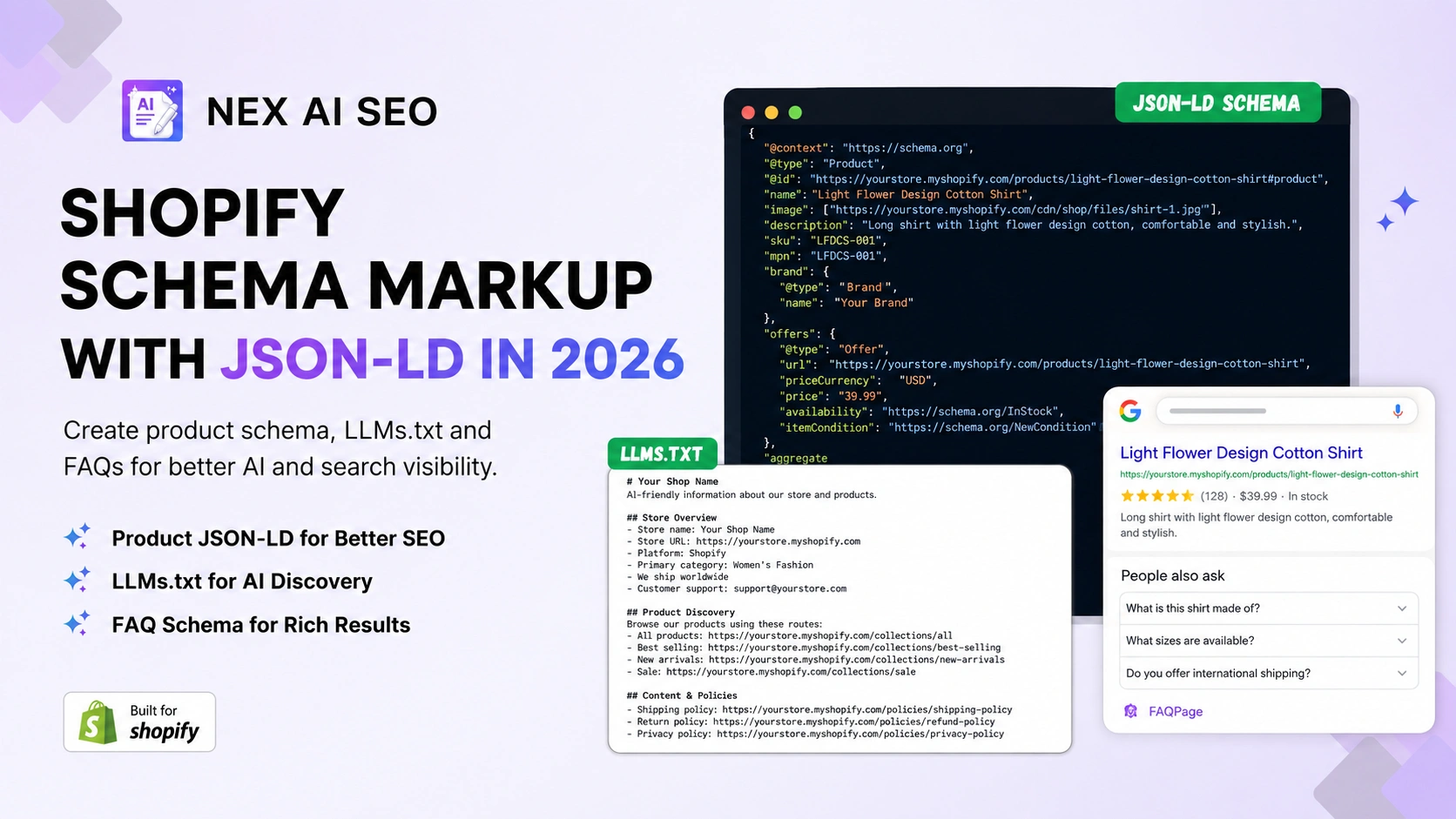
Shopify Schema Markup: How to Add JSON-LD Structured Data in 2026
Shopify schema markup helps search engines understand what your store pages represent, including products, prices, availability, articles, organization details and other ecommerce information. For Shopify merchants, JSON-LD structured data can make product information clearer to Google and can make eligible pages available for richer search appearances.
The challenge is that structured data can become technical quickly. Editing theme code, tracking required properties, checking existing schema and keeping markup aligned with changing product information is not how most merchants want to spend their time.
Nex AI SEO gives Shopify stores a simpler way to manage modern SEO workflows. Along with generating product descriptions, collection content, page copy, blogs and metadata, the app includes AI visibility tools for creating JSON-LD schema, LLMs.txt and FAQs. That means schema can become part of a broader SEO workflow instead of a separate developer task.
What Is Shopify Schema Markup?
Schema markup is structured information added to a webpage so search engines can identify important entities and attributes more precisely. JSON-LD (JavaScript Object Notation for Linked Data) is a common format for publishing that structured information, and Google recommends JSON-LD because it is generally easier for site owners to implement and maintain.
On an ecommerce product page, structured data can describe details such as the product name, offers, price, availability, ratings, shipping information and other supported properties. Google can use valid Product structured data to present product information in richer ways across Search, Google Images and other shopping-related experiences when the page is eligible.
SEO reality check
Structured data is not a shortcut that guarantees first-page rankings. Its job is to help search engines understand page information and make eligible content available for supported search features. Rankings still depend on relevance, quality, authority, competition, page experience and many other signals.
Why JSON-LD Matters for Shopify SEO in 2026
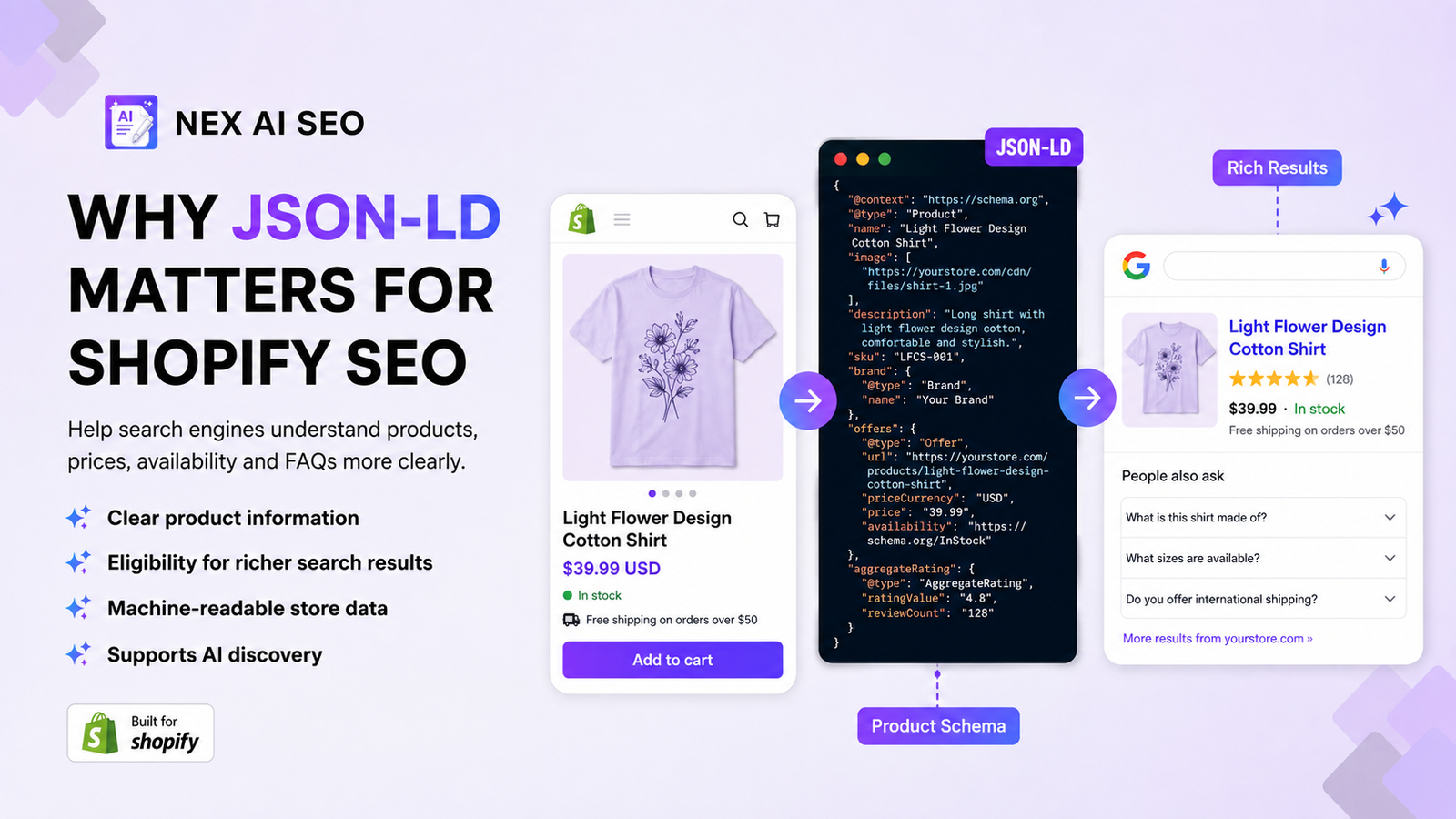
Modern ecommerce search is increasingly data-driven. A product page is more useful to a search engine when important facts are expressed consistently in both the visible content and machine-readable structured data. For Shopify stores, this can be particularly valuable when a catalog contains many products, variants, prices, availability states and changing content.
Help Google Understand Product Information
Support Richer Search Appearances
Create a More Machine-Readable Store
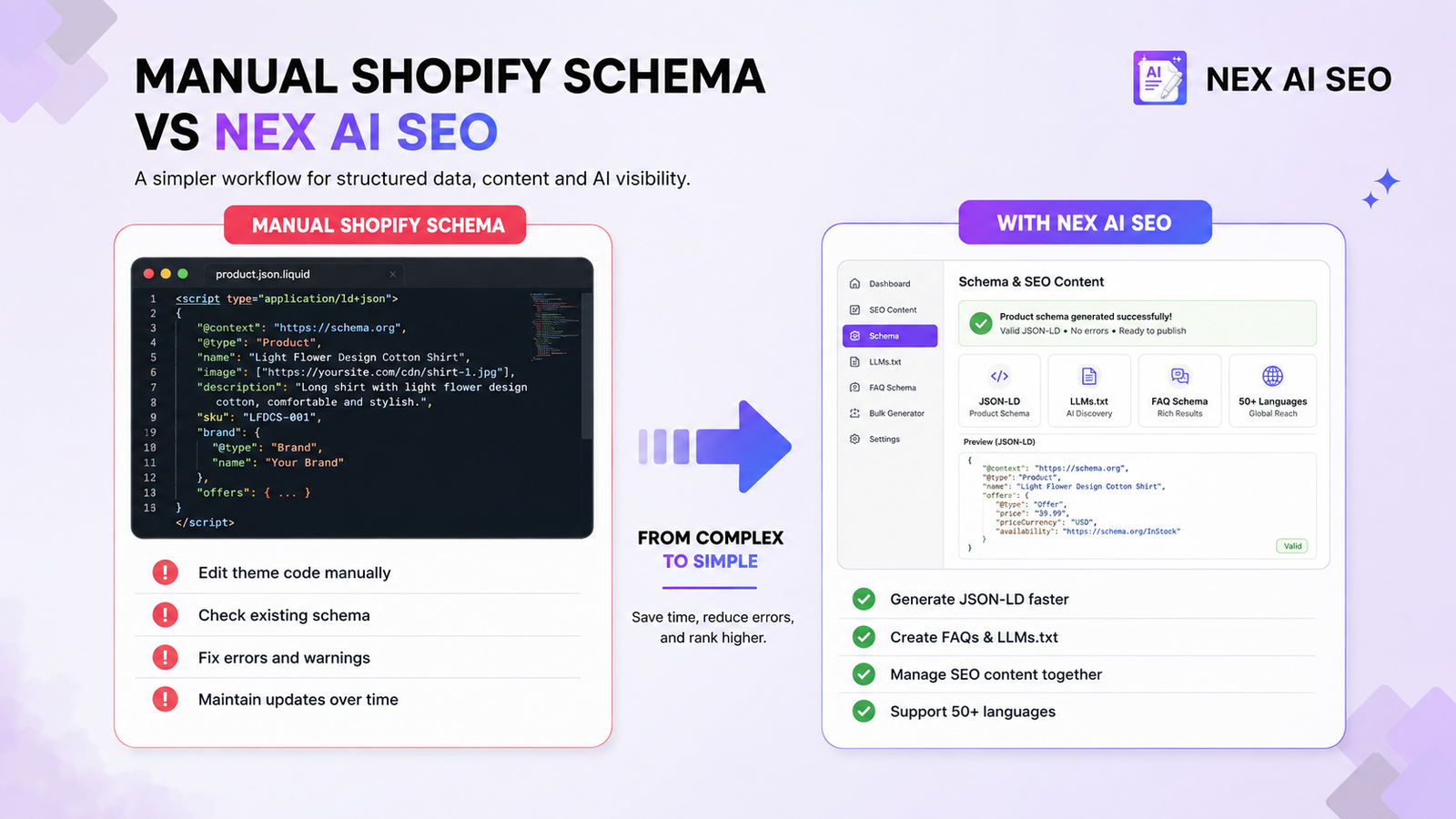
The Problem With Managing Shopify JSON-LD Manually
It is possible to work with structured data by editing Shopify theme files or using custom development, but the work is easy to underestimate. A store can already have schema coming from its theme, review app, SEO app or other integrations. Adding another block of JSON-LD without checking the existing markup can create duplicate or conflicting data.
Manual schema management also becomes harder as a store grows. Product prices change. Items go in and out of stock. New variants are added. Collections and blogs expand. The structured data needs to stay accurate and consistent with what shoppers can actually see on the page.
- You need to understand which schema already exists on the store.
- You need to know which properties are relevant to each page type.
- Your structured data should match the visible page content.
- You need to validate the markup and fix errors or warnings.
- You need to review the implementation when your theme or apps change.
For merchants who want to focus on merchandising and growth rather than theme code, an integrated Shopify SEO app can make this workflow much easier.
Nex AI SEO: An Easier Way to Add Shopify JSON-LD
Nex AI SEO Product Description is built around the repetitive SEO work Shopify merchants face every day. Its current toolset includes bulk product content generation, collection SEO, page and blog SEO, metadata optimization, multilingual content, analytics, and AI visibility features such as JSON-LD schema, LLMs.txt and FAQs.
Instead of treating Shopify schema markup as an isolated technical task, Nex AI SEO lets merchants handle it alongside the content and metadata that search engines and customers use to understand products and pages.
Generate JSON-LD Schema Without Writing Everything by Hand
Keep Technical SEO Closer to Your Content Workflow
Schema works best when it accurately reflects the content of the page. Because Nex AI SEO also creates product descriptions, metadata, collection content, page content, blogs and FAQs, merchants can manage several connected SEO tasks from the same Shopify-focused workflow.
Ready to simplify Shopify schema and SEO content? Install Nex AI SEO on Shopify
Simplify Shopify Schema Without Manual Coding
Go Beyond Schema With JSON-LD, LLMs.txt and FAQs
Schema is valuable, but it is only one part of how a modern Shopify store communicates information. Nex AI SEO combines JSON-LD with LLMs.txt and FAQ generation under its AI visibility features, giving merchants a broader way to organize useful, machine-readable and shopper-friendly content.
JSON-LD for Search Engines
LLMs.txt for AI-Oriented Site Guidance
FAQs for Better Product and Page Content
FAQs can make product and informational pages more useful by answering common questions about materials, usage, sizing, care, compatibility, shipping or other purchase considerations. Nex AI SEO can generate FAQs alongside other SEO content, helping stores build more complete pages without writing every question and answer manually.
Explore Nex AI SEO’s AI visibility features: View the Shopify App Store listing
Manage Schema and SEO Content in One Shopify App
Bulk product content
Collection SEO
Page and blog SEO
AI visibility
Global SEO
Generate product content in 50+ languages and use analytics to support international content workflows.
If you want a deeper look at Nex AI SEO’s broader content features, read our Shopify AI SEO app guide. For large catalogs, see our bulk product description generator for Shopify article.
Start with Nex AI SEO
Do More Than Schema With One AI SEO App
Create Shopify SEO Content in 50+ Languages
International stores often face a second scaling problem: every product, collection and SEO field may need localized content. Nex AI SEO supports SEO-friendly product content generation in more than 50 languages, allowing merchants to build multilingual content workflows without starting each page from a blank document.
For global Shopify stores, that can reduce repetitive writing and help teams maintain a more consistent content process across markets. As with any AI-generated content, merchants should review the final wording for accuracy, local terminology, brand voice and regulatory requirements before publishing.
How to Add JSON-LD Structured Data With Nex AI SEO
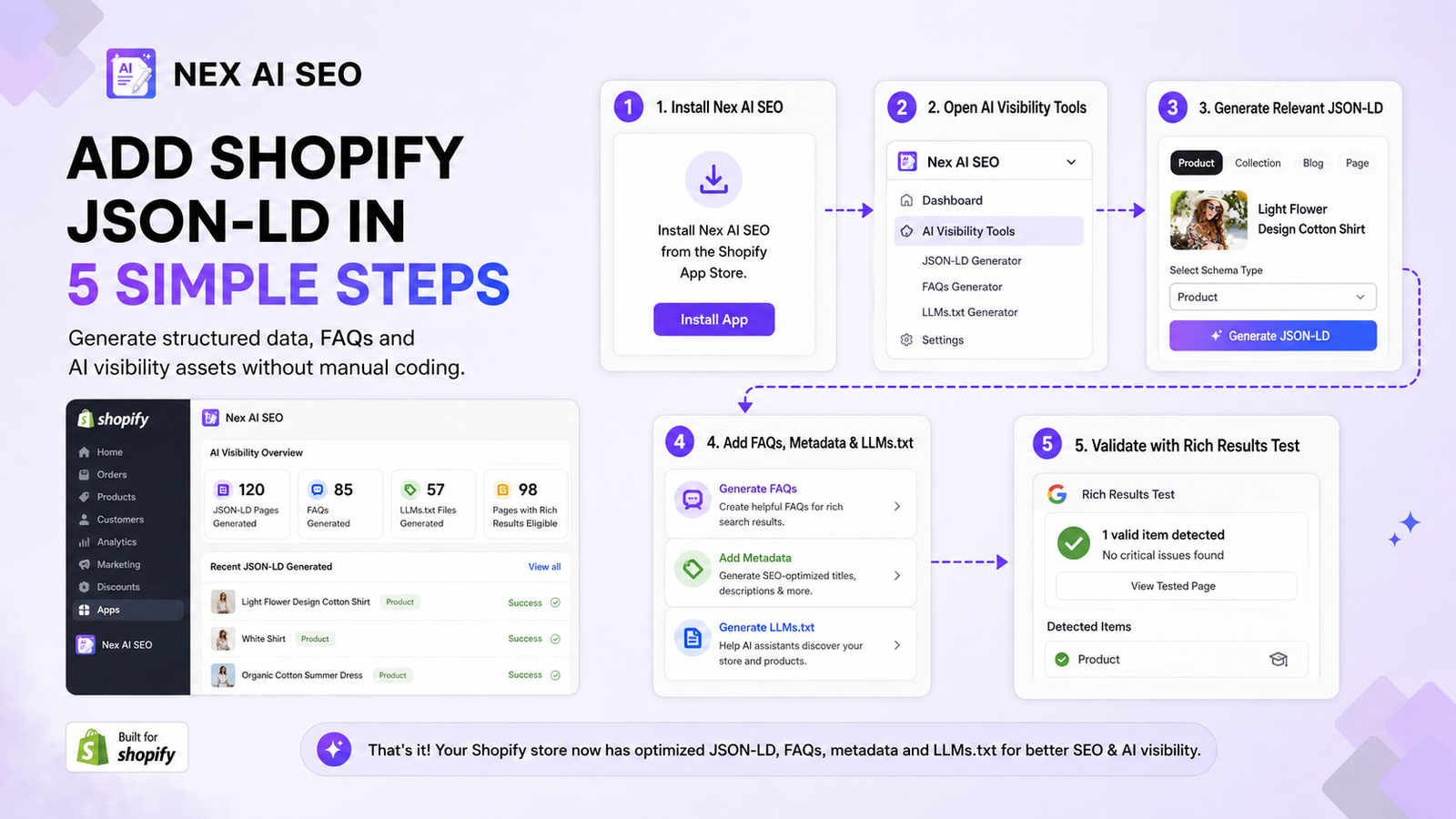
You do not need a long list of implementation methods for this workflow. If your goal is to manage Shopify schema markup through Nex AI SEO, keep the process focused and verify the result after publishing.
Step 1: Install Nex AI SEO
Open the Nex AI SEO Product Description listing in the Shopify App Store and install the app on the store you want to optimize.
Step 2: Open the AI visibility or schema tools
Use the app’s JSON-LD / schema functionality to work with structured data for your Shopify SEO workflow.
Step 3: Generate the relevant structured information
Create JSON-LD that is relevant to the page and the information actually visible on your store. Avoid adding markup for content that users cannot see or verify.
Step 4: Use supporting SEO features where useful
Add or improve product content, metadata, collection descriptions, FAQs and other relevant SEO elements from the same app. Use LLMs.txt as an additional AI-oriented site guidance layer when appropriate.
Step 5: Validate and monitor
Run the published URL through Google’s Rich Results Test, fix critical issues, and monitor Search Console for structured-data reports or implementation problems.
Google validation tool: Rich Results Test
Manual Shopify Schema vs. Nex AI SEO
SEO task | Manual workflow | With Nex AI SEO |
JSON-LD creation | Research properties and write/maintain structured-data code | Use the app’s JSON-LD/schema generation feature |
Product content | Write descriptions separately | Generate SEO-friendly product content, including bulk workflows |
Metadata | Create meta titles and descriptions page by page | Generate metadata within the same SEO workflow |
Collections | Write collection content manually | Generate collection descriptions and product metadata |
Blogs and pages | Use separate writing tools or manual copy | Generate blog and page SEO content |
AI-oriented visibility | Handle supporting files and content separately | Use JSON-LD, LLMs.txt and FAQ tools together |
Global content | Translate/localize workflows separately | Generate product content in 50+ languages |
Best Practices for Shopify Schema Markup
Whether you use Nex AI SEO, theme output or another implementation method, structured data should be accurate, relevant and aligned with what shoppers can see on the page.
- Match the markup to visible page content. Do not describe ratings, prices, availability or claims that are not actually present or accurate.
- Check existing theme and app schema before adding more. Duplicate or conflicting structured data can make troubleshooting harder.
- Keep product information current. Prices, availability and other offer data should reflect the live store.
- Use the correct schema for the page type and only include properties that are supported and truthful.
- Validate with Google’s Rich Results Test and fix critical errors before assuming the implementation is complete.
- Monitor Google Search Console after launch for structured-data issues and changes.
- Do not judge success only by whether a rich result appears. Google decides when and whether supported rich results are shown.
- Keep the visible content useful for shoppers. Structured data should support strong page content, not replace it.
Who Benefits Most From Nex AI SEO?
Nex AI SEO is particularly useful when SEO work is becoming repetitive or difficult to scale across a Shopify catalog.
- Shopify merchants who want JSON-LD support without making schema a manual coding project.
- Growing stores that need product descriptions, metadata and FAQs across many products.
- Large catalogs that benefit from bulk SEO content generation.
- Stores building collection-level SEO content.
- Teams publishing regular SEO blog or page content.
- International Shopify stores creating content across multiple languages.
- Merchants exploring AI visibility workflows in addition to traditional Google SEO.
Frequently Asked Questions About Shopify Schema Markup
Shopify schema markup is structured data added to store pages so search engines can understand page entities and attributes more clearly. JSON-LD is a commonly used structured-data format for ecommerce pages.
JSON-LD can describe structured information about products and other page types. For products, supported properties can include details such as offers, price, availability, reviews, shipping information and more. Google may use valid Product structured data for richer product search experiences when a page is eligible.
Schema markup does not guarantee higher rankings. Google uses structured data to understand page content and to determine eligibility for supported rich results. Organic rankings still depend on many relevance and quality signals.
Make Shopify Schema and SEO Easier With Nex AI SEO
Shopify schema markup is useful because it gives search engines a clearer, machine-readable description of your store content. But merchants do not need to turn structured data into a separate coding project.
Nex AI SEO brings JSON-LD schema together with product descriptions, metadata, collection SEO, blogs, pages, FAQs, LLMs.txt, analytics and multilingual content generation. The result is a more connected workflow for merchants who want to spend less time on repetitive SEO tasks and more time improving their store.