

Blog
AI Chatbot for Shopify Stores: Automate Sales & Support
Running a successful Shopify store is not only about attracting more visitors. You also need to help shoppers find the right products, answer their questions quickly, remove purchase doubts, and provide support when they need it.
That is where a Shopify AI chatbot can make a major difference.
Unlike traditional chat widgets that depend entirely on human agents or predefined responses, an AI chatbot can understand customer questions, provide relevant answers, recommend products, assist shoppers throughout their buying journey, and automatically handle many repetitive support conversations.
For Shopify merchants, this means a smarter way to combine AI-powered customer support, conversational selling, product discovery, and Shopify live chat in one customer experience.
In this guide, we’ll explain how an AI chatbot for Shopify works, what it can do, the features merchants should look for, and how it can help turn more store visitors into customers.
What Is a Shopify AI Chatbot?
A Shopify AI chatbot is an AI-powered conversational assistant designed to interact with customers visiting a Shopify store.
Instead of forcing shoppers to browse multiple product pages, search FAQs, or wait for a support agent, the chatbot allows them to simply ask a question.
A customer might ask:
“Do you have this shirt in black?”
“Which moisturizer is best for dry skin?”
“What size should I choose?”
“Do you ship internationally?”
“Where is my order?”
“Can you recommend a gift under $50?”
An intelligent Shopify chatbot can understand the customer’s intent and provide an appropriate response based on the information available from the store.
Depending on the Shopify chatbot app and its integrations, it may use product information, collections, FAQs, shipping policies, store policies, order information, knowledge-base content, and other approved store data to generate useful answers.
This makes AI chat much more powerful than a traditional scripted chatbot.
Shopify AI Chatbot vs. Traditional Chatbot
Traditional chatbots generally operate according to predefined rules.
For example, shoppers might be shown buttons such as “Track Order,” “Shipping,” “Returns,” and “Contact Support.”
These bots can be useful, but they work best when the customer’s question matches the options that have already been configured.
A Shopify AI chatbot takes the experience further.
Customers can communicate naturally instead of navigating through a fixed menu.
Someone could type:
“I need a black dress for a wedding under $100.”
Rather than returning a generic category link, an AI-powered shopping assistant may be able to understand the shopper’s requirements and recommend relevant products from the store.
That difference transforms the chatbot from a simple support widget into an interactive shopping assistant.
BOOST CART VALUE BEFORE CHECKOUT
Turn Your Cart Goal Into a Revenue Opportunity
Why Shopify Stores Are Adding AI Chatbots
Online shoppers frequently have questions before making a purchase.
They want to know whether a product is right for them, whether a particular variant is available, when their order will arrive, what the return policy is, or which product best fits their requirements.
If shoppers cannot find those answers quickly, they may leave the store without purchasing.
A Shopify AI chatbot helps reduce this friction by giving customers another way to interact with the store.
Instead of searching through pages, shoppers can ask.
Instead of waiting for an email response, they can receive immediate assistance.
Instead of browsing dozens of products, they can describe what they need.
This creates a more conversational ecommerce experience.
How a Shopify AI Chatbot Can Help Increase Sales
Help Customers Discover the Right Products
Large Shopify stores can have hundreds or thousands of products.
Traditional navigation works well when customers already know what they want. But many shoppers need guidance.
For example:
“I need running shoes for daily training.”
“Show me gifts for a 10-year-old.”
“Which laptop bag fits a 16-inch laptop?”
“I need skincare products for oily skin.”
A Shopify AI chatbot can turn these natural-language questions into product discovery opportunities.
Instead of making the customer manually filter through collections, the chatbot can guide them toward relevant products.
This makes AI chat especially valuable for stores with large catalogs, multiple variants, technical products, or products that require explanation before purchase.
Provide Personalized Product Recommendations
Product recommendation is one of the most valuable potential uses of an AI chatbot for Shopify.
Rather than displaying the same recommendations to every shopper, conversational AI can use information provided during the conversation to better understand what someone wants.
Imagine a shopper saying:
“I need a birthday gift for my wife. My budget is around $80 and she likes minimal jewelry.”
An AI shopping assistant can potentially narrow down suitable products much faster than traditional navigation.
The customer gets a more helpful buying experience while the merchant creates another opportunity to convert browsing into purchasing.
BOOST CART VALUE BEFORE CHECKOUT
Launch Free Shipping & Reward Goals Without Rebuilding Your Theme
Answer Pre-Purchase Questions Instantly
Small questions can create surprisingly large barriers to conversion.
A shopper may be interested in buying but still want to know:
Does this product come in another color?
What material is it made from?
How long does shipping take?
Is this suitable for beginners?
Will this accessory work with my device?
Can I return it if it doesn’t fit?
Providing fast answers can help remove uncertainty while purchase intent is still high.
This is one reason a Shopify AI chatbot can become more than a customer-service tool. It can act as an always-available sales assistant throughout the shopping journey.
Reduce Repetitive Customer Support Questions
Shopify support teams often answer the same questions repeatedly.
Customers ask about shipping, returns, sizing, product availability, order status, payment methods, store policies, and product details.
These conversations are important, but handling every basic question manually consumes valuable support time.
An AI chatbot can handle many common questions automatically and allow human agents to focus on situations that actually require personal attention.
The result is not necessarily replacing human support.
It is using automation for repetitive conversations while keeping people available for conversations where human judgment matters.
Shopify AI Chatbot and Live Chat Work Better Together
AI chat and live chat should not be treated as competing technologies.
The strongest customer experience often combines both.
AI can provide immediate assistance for common questions and product discovery, while Shopify live chat gives shoppers access to a real person when the conversation becomes complicated.
Consider a customer asking about a normal return policy.
An AI chatbot may be able to answer instantly.
But if the customer says:
“My package arrived damaged, one product is missing, and I was charged twice.”
That conversation may need a human support agent.
A well-designed system should recognize situations where automation is no longer appropriate and make human handoff simple.
This creates a better balance:
AI when automation is useful. Human support when personal attention is needed.
Important Features to Look for in a Shopify AI Chatbot
Not every chatbot provides the same capabilities. Before choosing a Shopify chatbot app, merchants should evaluate how deeply it understands the store and what actions it can actually perform.
Feature – Why It Matters
AI-powered conversations – Lets customers ask questions naturally instead of using fixed menus
Shopify integration – Helps the chatbot work with relevant store information
Product recommendations – Turns conversations into product-discovery opportunities
Product knowledge – Helps answer questions about products, variants and specifications
Live chat – Gives customers access to human support when necessary
Human handoff – Prevents complicated conversations from getting trapped in automation
Order assistance – Can help customers with order-related questions when supported
FAQ automation – Reduces repetitive customer-service conversations
Multilingual support – Helps stores communicate with international shoppers
Customizable chatbot – Keeps the experience aligned with the store’s branding
Conversation insights – Helps merchants understand what customers are asking
Mobile-friendly experience – Ensures chat works properly for mobile shoppers
The best solution will depend on your store size, catalog complexity, support volume, and sales strategy.
AI Chatbot as a 24/7 Shopify Sales Assistant
Your customers do not always shop during your team’s working hours.
Someone might visit your store late at night, during a weekend, or from another country.
A traditional live-chat-only strategy can leave those shoppers without immediate support whenever agents are unavailable.
A Shopify AI chatbot can keep the conversation available beyond normal business hours.
It can help answer common questions, guide visitors toward products, explain store information, and collect context before a human agent becomes involved.
For international Shopify stores, this can be particularly useful because customer activity often spans multiple time zones.
Instead of thinking of an AI chatbot only as automated support, merchants can think of it as an always-available first layer of customer assistance.
BOOST CART VALUE BEFORE CHECKOUT
Build a Smarter Shopify Cart Around Every Reward Goal
Turn Product Search Into Conversation
Traditional ecommerce search depends heavily on keywords.
Customers search:
“black running shoes”
“men waterproof jacket”
“wireless headphones”
Conversational shopping allows much richer queries.
A shopper might instead say:
“I need waterproof shoes for hiking that are comfortable enough to wear all day.”
That sentence contains several pieces of intent.
The shopper wants:
waterproof footwear, hiking suitability, comfort, and potentially products designed for longer use.
An AI-powered product assistant can potentially interpret these requirements and surface relevant products.
This is where conversational commerce becomes particularly powerful.
Instead of asking customers to understand the store’s category structure, the store starts understanding the customer’s request.
Use AI Chat to Improve Product Recommendations
Traditional product recommendations often rely on categories, purchase history, related products, or manually configured upsells.
Conversational AI adds another signal:
what the customer is telling you right now.
A shopper can explain their needs directly.
This makes conversation valuable not just for answering questions, but also for understanding purchase intent.
For example, the difference between:
“Show me headphones.”
and:
“I need comfortable noise-cancelling headphones for long international flights under $200.”
is enormous.
The second query provides context that can produce significantly more relevant recommendations.
A capable Shopify AI chatbot can use this conversational context to make the shopping experience feel more like interacting with a knowledgeable sales associate.
AI Chatbot for Shopify Customer Support
Sales are only one side of the experience.
After customers purchase, they still need help.
Common post-purchase questions include order tracking, delivery information, cancellations, returns, exchanges, refunds, warranty questions, and product usage.
An AI chatbot can act as the first point of contact for many of these conversations.
However, merchants should choose automation carefully.
Sensitive or complicated situations should be escalated to human support rather than forcing customers through endless automated responses.
The goal should be faster resolution, not automation for the sake of automation.
Can a Shopify AI Chatbot Replace Live Chat?
Not completely—and it usually shouldn’t.
AI excels at speed, availability, repetitive questions, product information, and handling many conversations simultaneously.
Human agents excel at judgment, empathy, negotiation, unusual situations, and sensitive customer problems.
The best approach is therefore often a hybrid model.
The AI chatbot handles straightforward conversations first.
When required, the conversation moves to live chat with a human.
This helps merchants scale customer service without sacrificing the human experience.
AI Chatbot vs. Shopify Live Chat
Shopify AI Chatbot – Shopify Live Chat
Available automatically – Depends on agent availability
Handles multiple conversations – Agent capacity is limited
Good for repetitive questions – Good for complex questions
Can guide product discovery – Human can provide personalized advice
Provides immediate responses – Response speed depends on support team
Can automate basic support – Better for sensitive cases
Works well outside business hours – Best when agents are online
Rather than choosing only one, Shopify merchants can use AI chatbot automation alongside live chat.
How to Choose the Best Shopify AI Chatbot
Start with your business goals.
A store looking primarily to reduce support tickets may prioritize FAQ automation, order assistance, and human handoff.
A store focused on increasing conversion may care more about product recommendations, conversational product search, cross-selling, and sales-focused chat.
Stores with international audiences might prioritize multilingual conversations.
Larger businesses might need advanced integrations, reporting, multiple agents, and more control over AI behavior.
Most importantly, evaluate whether the chatbot understands your actual Shopify store.
A generic chatbot that only generates conversational responses is very different from a Shopify-focused AI assistant that can use relevant product and store knowledge.
How to Add an AI Chatbot to a Shopify Store
For most merchants, the easiest approach is using a Shopify chatbot app.
After selecting an app, installation typically begins through Shopify, followed by configuring the chatbot’s knowledge, appearance, behavior, automation rules, and any available integrations.
Before launching it across the entire store, test real customer scenarios.
Ask product questions.
Ask vague questions.
Test shipping and return questions.
Try different product recommendations.
Test questions where the bot does not know the answer.
Most importantly, test the human-handoff experience.
A chatbot should know both how to answer and when not to answer.
Where Should You Display the Shopify Chatbot?
The chatbot should be easily accessible without interrupting the shopping experience.
For most Shopify stores, a persistent chat widget works well because customers can access assistance from product pages, collection pages, the cart, and other important areas.
The conversation should also work smoothly on mobile.
Mobile ecommerce visitors have less screen space and less patience for complicated navigation. Being able to ask a direct question can therefore be particularly useful.
The chatbot should help shoppers—not block products, buttons, navigation, or checkout actions.
How AI Chatbots Can Reduce Cart Abandonment
Not every abandoned cart happens because of price.
Customers also hesitate because they have unanswered questions.
They may be uncertain about sizing.
They may not understand shipping times.
They may want to confirm compatibility.
They may be comparing two products.
They may not understand the returns policy.
A Shopify AI chatbot gives shoppers a way to resolve these doubts while they are still on the store.
That does not mean every chatbot conversation will create a sale.
But providing immediate access to useful information removes one more potential barrier between interest and checkout.
Shopify AI Chatbot for Small Stores
AI chat is not only for large Shopify Plus brands.
Smaller merchants often have limited customer-support resources, which makes automation particularly useful.
A small team may not be able to respond instantly to every visitor throughout the day.
An AI chatbot can provide a first layer of assistance while allowing the merchant to step into important conversations when necessary.
The key is starting with useful, focused automation.
Automate your most common questions first.
Then gradually expand into product discovery, sales assistance, recommendations, and other workflows as you learn how customers actually use chat.
Shopify AI Chatbot for Large Ecommerce Stores
Larger catalogs create different challenges.
Customers can struggle to navigate thousands of products, variations, collections, specifications, and compatibility requirements.
For these stores, conversational product discovery can become especially valuable.
Rather than applying filter after filter, shoppers can explain what they are looking for.
Large stores can also receive significant customer-support volume, making AI automation useful for handling repetitive conversations before they reach human agents.
The larger the store becomes, however, the more important integration quality, security, permissions, accuracy, analytics, and human escalation become.
The Future of Shopify Shopping Is Conversational
Traditional ecommerce is built primarily around menus, filters, categories, search boxes, and product pages.
Those tools are not disappearing.
But AI introduces another interface:
conversation.
Instead of navigating every step manually, shoppers can increasingly describe what they want.
“Help me choose.”
“Compare these products.”
“Find something within my budget.”
“Which one works for me?”
“Where is my order?”
This shift from clicking through interfaces to communicating through natural language is turning chat from a small customer-support feature into a larger part of the ecommerce buying experience.
For Shopify merchants, the opportunity is not simply adding another chat bubble.
It is creating a more helpful way for customers to interact with the store.
Turn Conversations Into Sales With a Shopify AI Chatbot
Customers often arrive at a Shopify store with questions.
The faster those questions are answered, the easier it becomes for shoppers to make confident purchasing decisions.
A Shopify AI chatbot can provide instant assistance, recommend relevant products, automate repetitive support, help customers navigate the store, and connect conversations with human agents through live chat when necessary.
For merchants, that means fewer repetitive conversations and more opportunities to assist shoppers while purchase intent is high.
For customers, it means getting useful answers without spending time searching through multiple pages or waiting for support.
If you want to transform your Shopify store from a static shopping experience into a more conversational one, an AI-powered chatbot is a strong place to start.
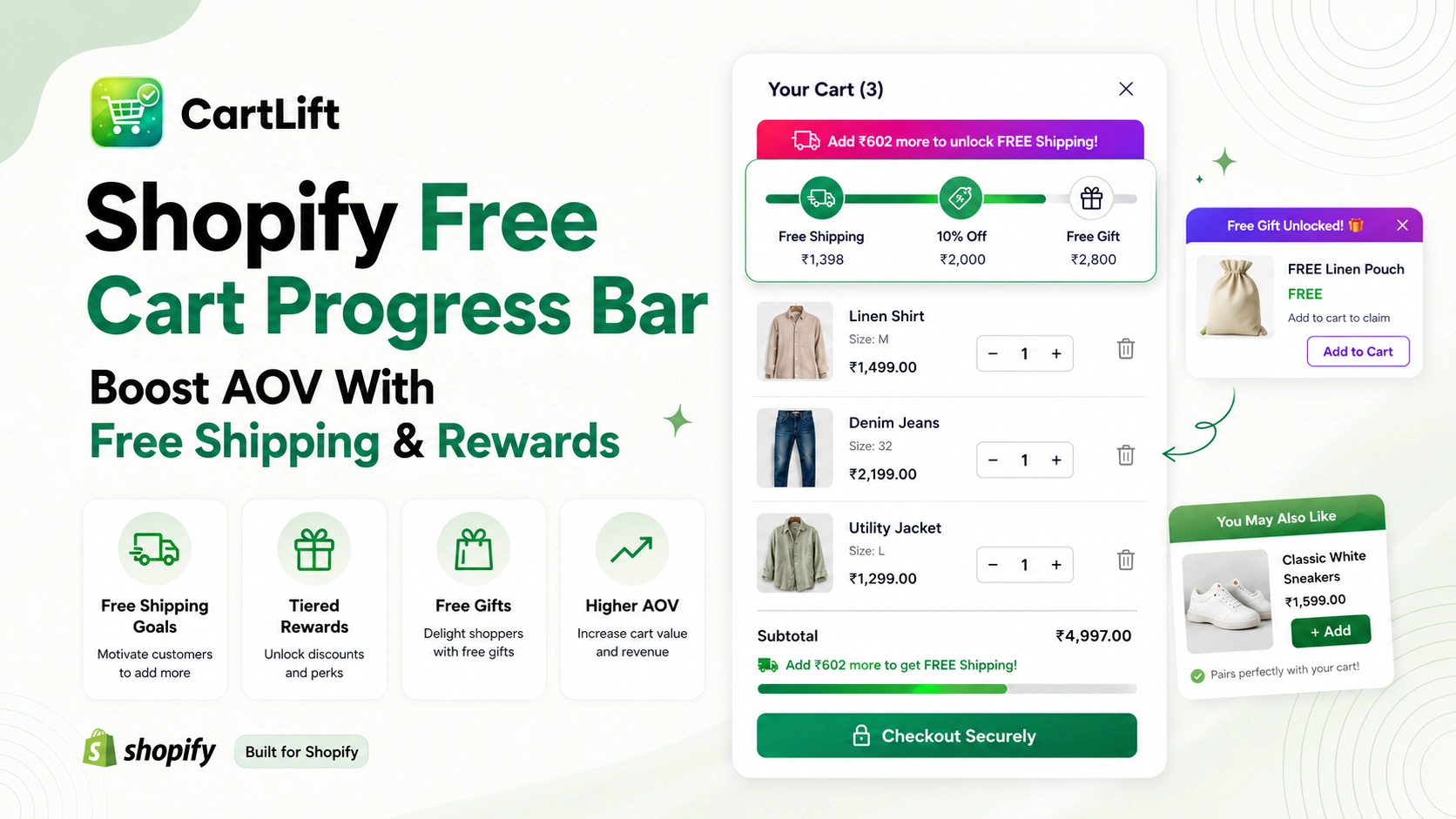
Use a Shopify Free Cart Progress Bar to Make Every Cart Goal Clearer
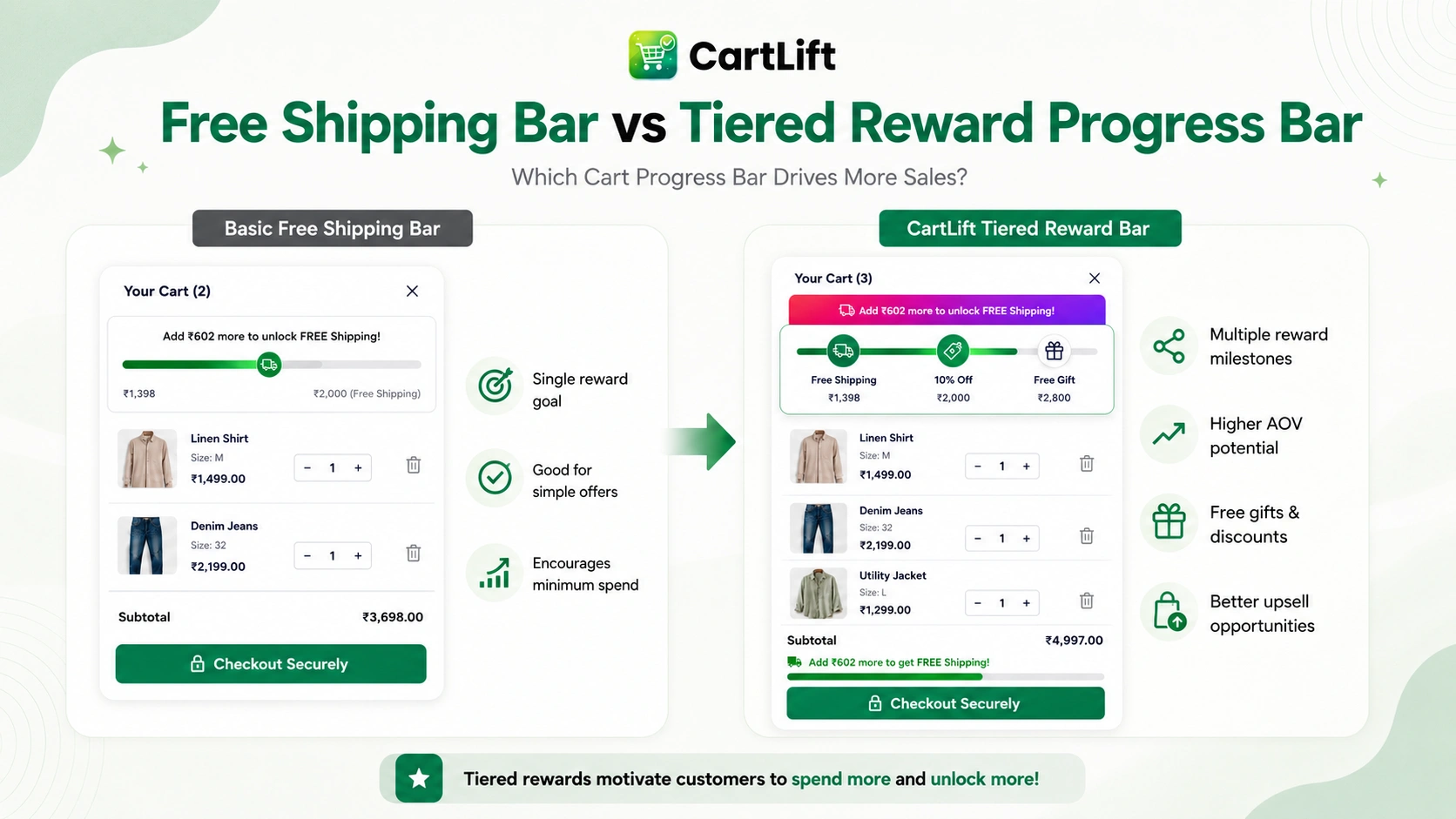
A Shopify free cart progress bar is a visual indicator inside the cart that shows how close a customer is to a reward threshold, such as free shipping, a free gift, or a discount. It updates as the cart changes so the shopper can see the remaining amount needed to unlock the reward.
A progress bar does not guarantee a higher average order value, but it can make reward thresholds more visible and give shoppers a clear reason to add another relevant item. The impact depends on the threshold, reward, products, traffic, and overall store experience.
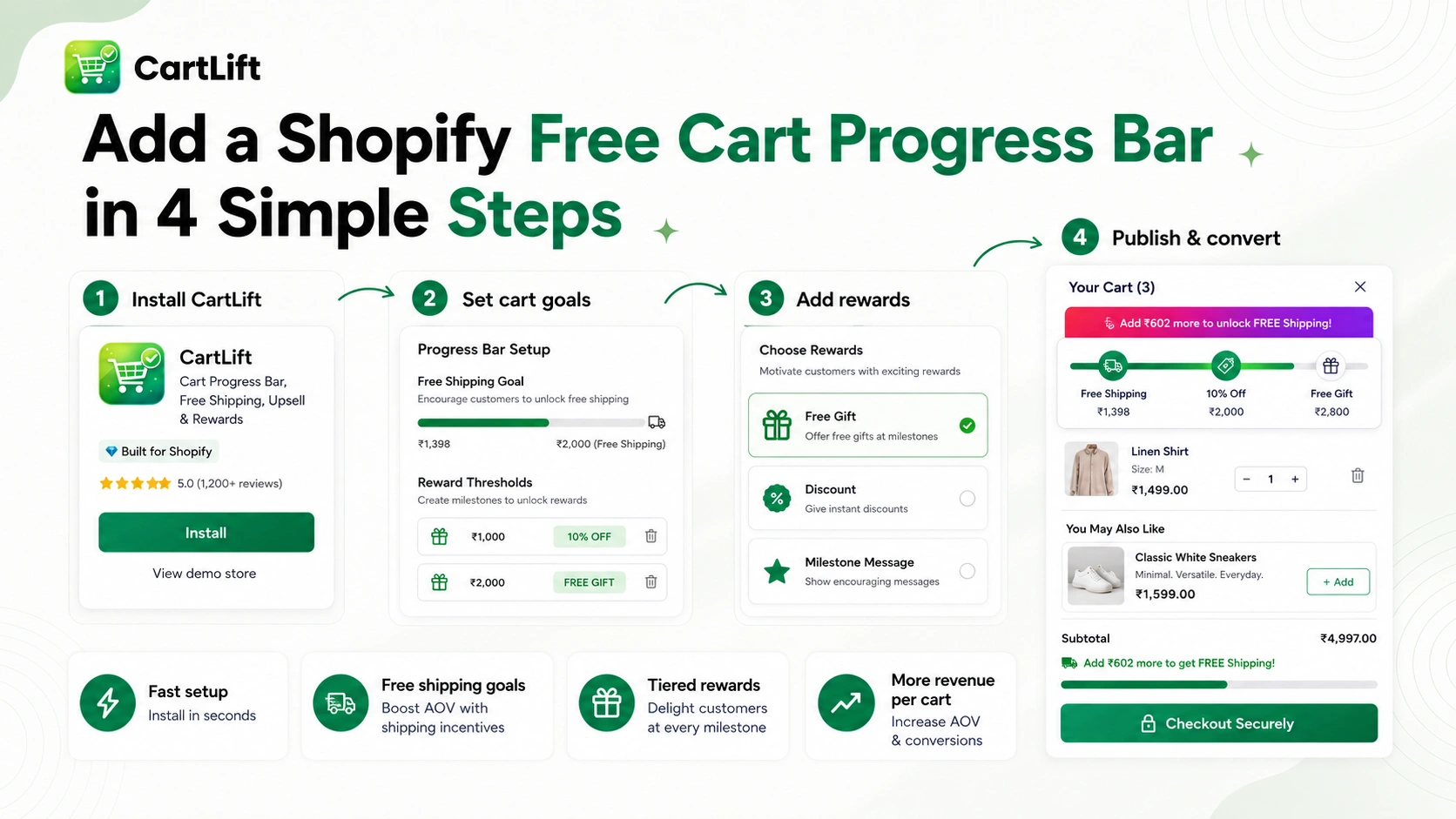
Yes. Shopify can support free shipping rules with minimum purchase requirements, and a cart app can display progress toward that threshold. CartLift includes a free shipping progress bar as part of its slide cart drawer.
Yes. CartLift includes a multi-tier progress bar and supports free gifts based on cart total value. Merchants can structure the campaign around more than one reward milestone when the economics and customer experience support it.
Yes. A free gift can be used as a reward after a defined cart-value goal. CartLift supports free gifts and multi-tier reward progress, making it possible to combine shipping and gift incentives inside the cart.
Yes. CartLift supports cart upsells, cross-sells, product recommendations, and frequently bought together offers. These can be useful near a reward threshold because they give shoppers relevant products they can add to reach the next goal.
Yes. CartLift lists BXGY and BOGO offers among its current cart-conversion features. These can complement cart-value rewards when a campaign is based on product quantity or specific qualifying items.
At the time of writing, CartLift: Cart Drawer & Upsell is listed as Free on the Shopify App Store. Because app plans can change, check the current listing before publishing or promoting pricing details.
There is no universal threshold. Review your normal cart values, shipping costs, gross margins, and promotional goals. A useful threshold should be achievable enough to motivate an additional purchase while still making financial sense for the store.
For many stores, a small number of clear tiers is easier to understand than a long reward ladder. Start with one primary goal and add another tier only when the additional reward is meaningful and the cart remains easy to scan on mobile.